
Washington Arrest History
A Washington arrest can produce several Washington records. A city police department, county sheriff, Washington State Patrol trooper, tribal officer, campus officer, or other authorized agency creates an incident or arrest report. A Washington jail then creates the booking number, intake time, fingerprints, custody status, alleged charges, and bond fields. If a prosecutor files a case, the court creates a separate docket. Each source answers a different question.
The Washington State Patrol maintains WASIS, the statewide computerized criminal-history system, and ABIS, the fingerprint database. A fingerprinted booking can reach those systems through livescan or card submission. WATCH, the public portal, is not a live statewide booking log. Its public result can include Washington convictions and arrests less than one year old while a disposition remains pending, but older nonconviction information is generally outside the ordinary public return.
Note: Washington arrest history can omit an unreported event, so a negative name search never proves that no local record exists.
Washington Arrests by the Numbers
WASPC's official Crime in Washington 2024 report counted 156,092 Washington arrests, or 19.4 per 1,000 residents. Its definition is broad. It includes physical arrests, citations, and served summonses, so the total is not a count of Washington jail bookings or convictions. The report counted 67,023 on-view arrests without a warrant, 46,090 warrant custody events, and 42,979 citations or summonses.
The same Washington report found that 15.9 percent of arrests involved DUI, 13.9 percent involved people ages 18 through 24, and 94.4 percent were reported unarmed. These figures describe reported events, not unique people. WSP also reported 171,823 criminal fingerprint transactions in 2024. That is a measure of repository work and cannot be substituted for the statewide arrest total.
How Washington Arrests Reach the Record
At Washington booking, a qualifying Washington arrest begins an arrest cycle. The arresting agency sends fingerprints and charge data to WSP. A process-control or transaction-control number helps tie the later prosecutor and court disposition to that event. WAC 446-16-090 describes the Washington arresting-agency and prosecutor workflow. WAC 446-16-060 requires final disposition reporting when a fingerprinted charge is resolved, and RCW 10.98.090 addresses felony and Superior Court reporting.
Data flow: Arrest › Booking › Fingerprint Submission › Washington State Patrol Entry › Court Disposition
The chain can break. No prints may have been taken. A card may be hard to read. A transaction number may not link. A court outcome may wait for entry or arrive under a different name. WSP warns that WASIS may omit arrests and dispositions. The source agency and court should therefore be checked when a Washington arrest entry lacks an outcome.
Four Washington Arrest Record Layers
One Washington event can yield four Washington records with different fields. The arresting agency report describes probable cause, officers, location, witnesses, evidence, and the alleged offense. The Washington jail booking record tracks intake, custody, charge, bond, and release. The court file shows only charges a prosecutor filed, along with hearings and the result. WASIS compiles the fingerprinted arrest cycle and a later reported disposition.
Differences do not always mean that one source is false. A jail roster captures allegations at intake. A prosecutor may amend or decline them. The court may dismiss one count and resolve another. WSP may not receive that result at once. Use the report for arrest circumstances, the jail for custody, the court for the filed case, and WSP for the statewide compiled history.
Note: Compare Washington arrest sources by purpose and date before treating a field difference as an error.
Looking Up Arrests in Washington
A thorough Washington arrest lookup follows the event from local custody to the Washington statewide record. Start with place and time. The Washington county jail usually has the freshest custody data, while a police or sheriff records channel holds the report. Washington court filings can lag behind booking. WATCH is useful for reportable statewide history but does not replace these sources.
- Identify the location and arresting agency. Check its blotter or official records route and ask for the incident or arrest report.
- Open the county jail roster, app, daily list, or booking line. If the person moved, ask which facility received the transfer.
- Use the directory of all 39 Washington counties to reach the local jail and court channels for the place of arrest.
- Search district or municipal court for a misdemeanor or probable-cause matter and Superior Court for a filed felony.
- Use WATCH for its Washington public conviction return and qualifying recent pending arrests, with name-match limits in mind.
- If custody moved, use Washington DOC for a state sentence or the federal BOP locator for federal custody.
A focused Washington Public Records Act request can seek an existing report, booking sheet, or dispatch chronology from the agency that holds it. Agencies may redact protected identities, active investigative details, and other exempt information. Court pleadings and orders are requested from the court under GR 31, not through an ordinary agency PRA demand.
Washington Jail Register Limits
RCW 70.48.100 makes a Washington jail register public. Its core fields are the person's name, the cause and time of confinement, and the time and manner of discharge. Other Washington jail records are confidential except for authorized recipients and uses. That distinction means the Washington statute does not promise every intake form, medical note, classification record, or investigative detail to the public.
Booking photographs are not part of the generally public register. Washington does not require one statewide mugshot gallery, and local roster practices differ. A booking image also adds no proof of guilt. The sound route is to use official agency records for a defined need, avoid republishing photographs, and read the court docket before drawing a conclusion about how an arrest ended.
Washington access rule: ask the jail for the public register and identifiable public records, but expect lawful limits on other jail material and booking photographs.
Inside a Washington Arrest Record
The phrase “Washington arrest record” can refer to an agency report, Washington jail booking, WASIS arrest cycle, or court probable-cause filing. The field list below reflects the public-facing parts of those Washington layers. It does not mean each source displays every field. Sensitive identifiers, protected witness information, juvenile data, and active investigative content can be restricted or redacted.
| Name & Identifiers | Name, date of birth or age, sex, descriptors, and aliases may appear; fingerprints and SID support identity in WASIS. |
|---|---|
| Arrest Date & Location | Shows when and where the Washington arrest or citation event occurred. |
| Arresting Agency | Identifies the police, sheriff, WSP, tribal, campus, or other authorized agency. |
| Charges at Booking | Lists intake allegations or warrants, which can differ from charges a prosecutor files. |
| Booking Number & Photo | The jail uses a local booking identifier; photo access is limited by Washington jail-record law and local policy. |
| Bond / Release Status | May show bond terms, current custody, transfer, or the date and manner of release. |
An arrest report may also include officers, witnesses, evidence, incident number, alleged statute, probable-cause narrative, and destination. A WASIS cycle instead emphasizes fingerprints, arrest agency and number, arrest date, transaction identifier, charges, and reported dispositions. The later court judgment remains the best source for the case result.
Washington Arrest Custody Routes
Washington custody searches divide into three systems. A Washington county jail holds many people awaiting trial and some serving local sentences. Washington DOC holds people serving state felony sentences after transfer. The Federal Bureau of Prisons covers federal custody. Searching the wrong layer is a common reason a Washington arrest lookup appears to go cold after a transfer.
The Washington DOC search terms show that its locator is for state incarceration, not a county booking roster.
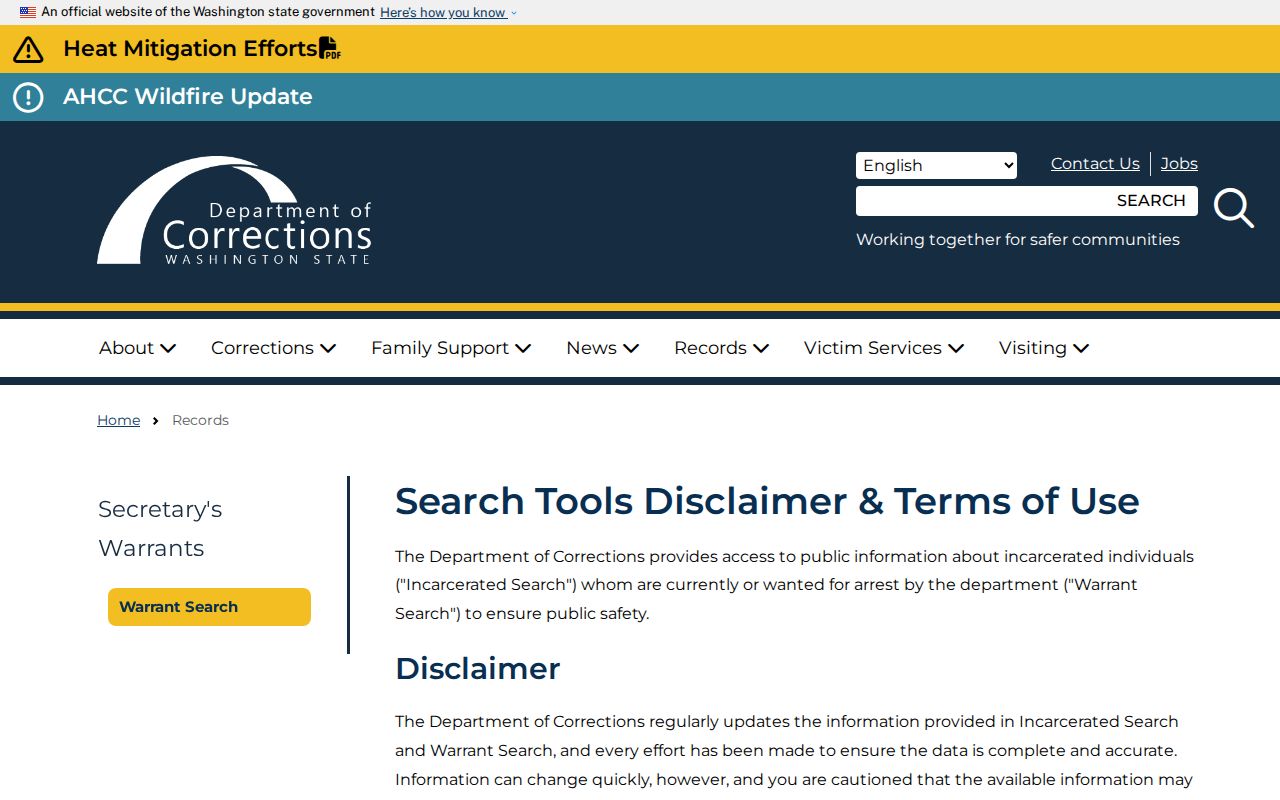
Washington DOC search uses a DOC Number or last name, with first name optional, and may show only limited status or location detail.
Washington VINELink can provide custody-status searches and notifications where the custodial agency participates.
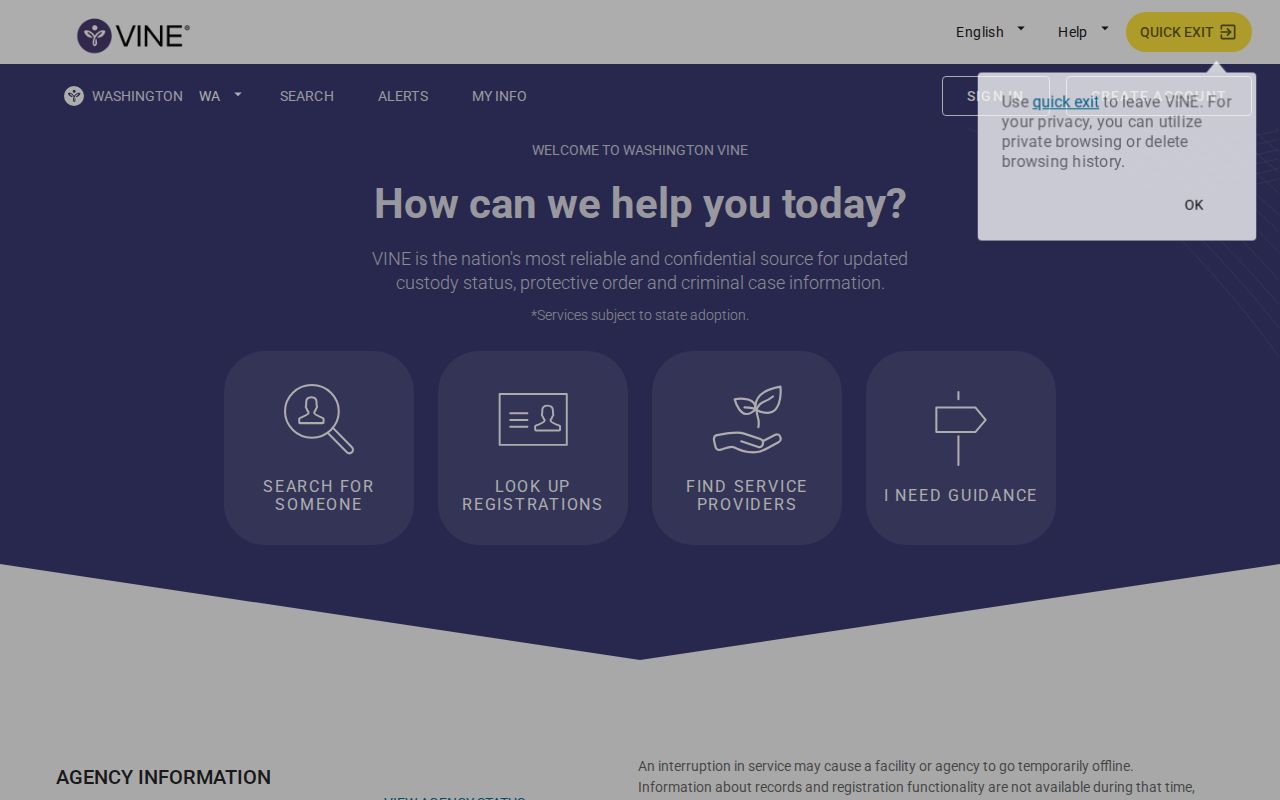
VINELink is a notification tool, not a Washington criminal-history report, and available events depend on the participating agency.
The Federal Bureau of Prisons locator is the separate route for federal custody and release history since 1982.
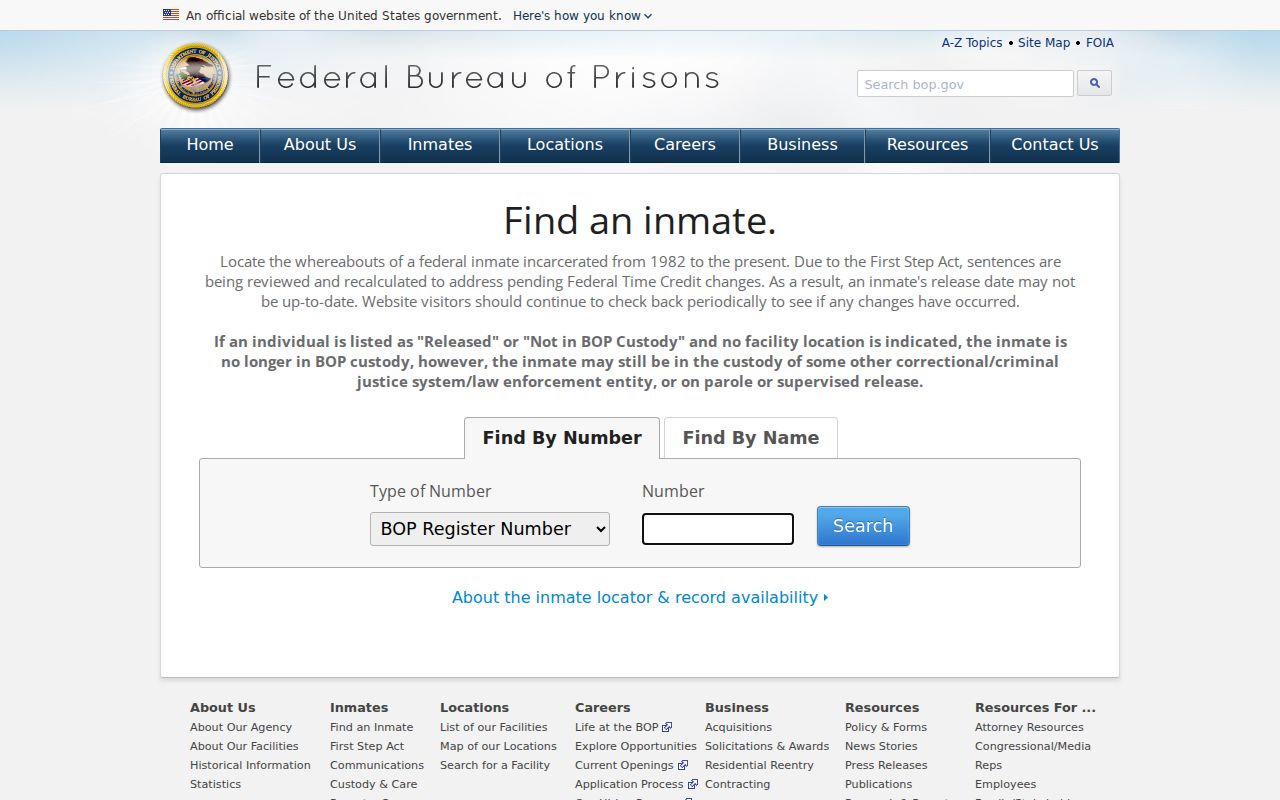
A federal result does not appear in a Washington county jail roster or DOC search simply because the arrest occurred within the state.
Note: Follow the Washington custody transfer before repeating name searches across systems built for different populations.
Arrests vs Convictions in Washington
A Washington arrest records an accusation event based on probable cause. A Washington conviction records guilt through a plea, verdict, or other qualifying adverse disposition. The distinction affects both meaning and access. Public WATCH results broadly provide Washington conviction data, while ordinary public access to older nonconviction criminal-history information is limited under chapter 10.97 RCW.
| Arrest Record | Conviction Record | |
|---|---|---|
| Created by | Arresting agency and jail begin the Washington event. | A court judgment is reported into the state history. |
| What it proves | A person was arrested, cited, or held on probable cause. | Guilt was established through the court process. |
| Public access | Local reports and jail registers vary; older nonconviction CHRI is limited. | Washington conviction data may generally be disseminated. |
| Relief route | Qualifying nonconviction law-enforcement data may be deleted under RCW 10.97.060. | A qualifying conviction may be vacated by the sentencing court under the applicable statute. |
Note: A Washington arrest entry without a disposition is not proof of guilt; verify the filed case and signed court outcome.
When Washington Arrest Sources Disagree
If a Washington jail roster and court charge disagree, save the booking number and locate the court case. Check whether the Washington prosecutor filed a different count, amended the allegation, or declined the case. The jail may retain the intake label while the docket shows the legal charge. If custody has ended, the roster may disappear even though the report and court file remain.
If the court has a final Washington disposition but WATCH does not, obtain the signed order. Confirm that the court docket is current. The source court, prosecutor, or agency may need to correct or resend data, and WSP's record-review process can use certified source proof. Do not treat a mismatch as a conviction, and do not assume the newest-looking portal holds the controlling record.
Missing Washington Arrests in WATCH
A recent Washington arrest may be absent from WATCH because it was not fingerprinted, has not reached WASIS, was indexed under another name, or is still awaiting review. A Washington citation can create an arrest statistic or court case without a jail booking. WATCH also is not designed as a real-time Washington roster. Search the arresting agency, jail, and likely court before deciding the event is missing.
A WATCH “No Exact Match” means no matching public Washington conviction record was found under the submitted identifiers. It does not prove no arrest, court case, sealed record, federal case, out-of-state record, or unreported event exists. “Duplicate Match” means identifiers collide. “Pending” means WSP review, normally within 24 to 48 hours. Fingerprints, not names, provide conclusive identity for a WSP record review.
Washington Arrest Records by County
Bookings, blotters, and jail rosters live at the county or city level in Washington. The Washington arresting agency holds the incident report, the jail holds the booking record, and the filing court holds the criminal case. Washington local systems range from web rosters and daily files to apps or phone-only access. There is no dependable public statewide page that replaces all of them.
Use the Washington county directory to reach the place where the event occurred. Then compare the local record with the Washington criminal court case if charges were filed. This county route is the most direct path for fresh booking detail, while WSP remains the source for the state's compiled criminal-history product.