
What the Washington State Patrol Is
The Washington State Patrol Criminal Records Division is Washington's central criminal history repository operation. Its Identification and Criminal History Section administers the Washington State Identification System, or WASIS, and the public Washington Access to Criminal History service, known as WATCH. The same division supports fingerprint and biometric operations and Washington's connection to national criminal justice information systems. It is a compiler. WSP does not replace the police agency, jail, prosecutor, or court that made each source record.
Washington law gives WSP authority to collect, maintain, and disseminate this data through chapters 10.97, 10.98, and 43.43 RCW. The repository joins structured arrest cycles with final case outcomes. A public report is narrower than the data available for a certified criminal justice purpose. It excludes sealed and vacated cases, older public nonconviction data, and misdemeanor traffic violations. A missing item can also reflect a source reporting gap. For that reason, the WSP compilation and the source county file should be read together when accuracy matters.
The WSP Criminal Records contact page provides current help channels and counter details.
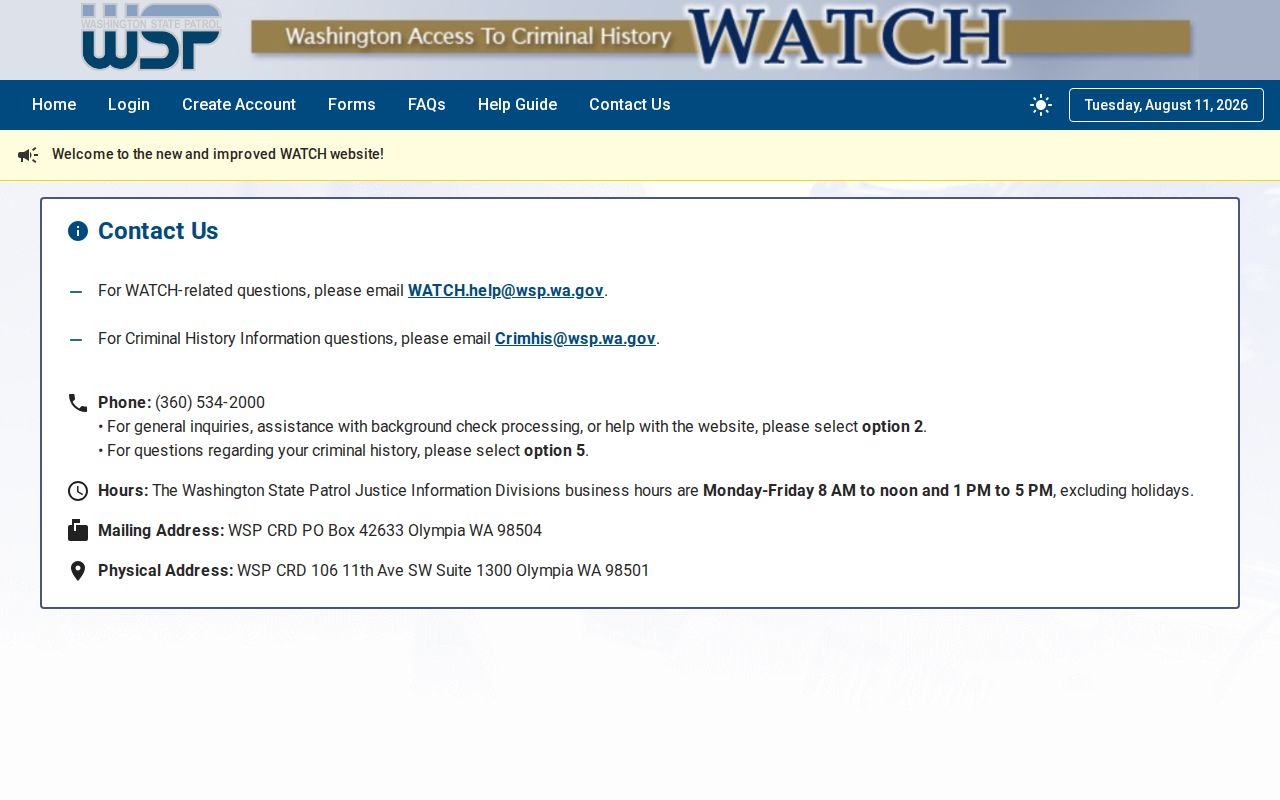
Those contacts separate portal support from questions about the content of a Washington criminal record.
WSP ABIS by Numbers
WSP reported in February 2025 that its Automated Biometric Identification System held prints for more than 2.2 million people. Those identities came mainly from 7.8 million booking events. The figures measure repository scale, not a current criminal population. One person may account for more than one booking event. WSP also reported that ABIS forwards qualifying Washington arrest fingerprints to the FBI Next Generation Identification system.
The WSP 2024 Annual Report counted 309,754 civil fingerprint background-check transactions and 171,823 criminal fingerprint events. It also reported 37,477 records vacated during the year. These are transaction and workflow totals. They are not unique people, convictions, or arrests. Their value is operational: Washington State Patrol processes a large stream of fingerprints, dispositions, record relief orders, and requests. That scale helps explain why a transaction-control number and clear source documents matter when a record needs correction.
Note: WSP biometric counts show system workload and should never be read as a count of people with current Washington convictions.
WSP Criminal History Check Options
Washington State Patrol offers several official routes. WATCH is the fast public name and date-of-birth search. A mailed form offers the same public conviction-history product without an online search session. A fingerprint-based Washington request uses a full fingerprint card and provides a conclusive identity match. A person reviewing their own record can then identify a disputed arrest cycle or disposition and use WSP's challenge process. The Washington Courts index is a separate case-finding tool, not a WSP product and not a rap sheet.
| Product | Who May Order | What It Returns | Cost |
|---|---|---|---|
| WATCH name and DOB search | Any public user with a credit-card or billed account | Washington conviction data, qualifying pending arrests under one year, and registration information | $11 each, including no match |
| Online notarized letter | WATCH user after a result | Notarial authentication added to the result and sent by mail | $15 each |
| Mailed name and DOB request | General requester | The public Washington conviction-history product based on identifiers | $32 |
| Fingerprint-based Washington request | Record subject or authorized requester with a full card | Biometric match against the Washington record | $58, plus capture cost |
| Own-record review and challenge | The person named in the record | Inspection and a route to dispute a specific entry | Depends on request and fingerprint channel |
The current portal fee controls when an older PDF differs. WSP's form says mailed responses may take seven to fourteen business days. A pending WATCH response normally posts after staff review within 24 to 48 hours.
Note: Each WATCH attempt costs $11 even when no matching Washington public criminal history is returned.
WSP Identification Timeline
Washington's identification records began at the state penitentiary in the early 1900s. The Bureau of Criminal Identification moved to WSP in 1937, shifted to the Department of Institutions in 1955, and closed in 1961 with more than 660,000 master cards. The Legislature created the modern WSP Identification Section in 1972. It opened in 1974 with about 20,000 computerized records drawn from commitment fingerprints.
Technology changed the link between identity and case outcome. AFIS planning began in 1986, and an NEC system with almost 400,000 records went live in 1988. Washington became an FBI single-source contributor in 1992. A process-control-number project began in 1993 to tie a fingerprint booking event to prosecutor and court disposition reports. WATCH launched in January 1998 as an instant exact-name and DOB search. WSP added fingerprint services in 1999, livescan in 2000, FBI electronic exchange in 2002, and an ABIS upgrade in 2014.
That history explains the mix of old and new records. Older paper data, later electronic conversions, and modern livescan events do not all carry the same identifiers. WSP's 2001-03 improvement effort processed more than 1.8 million documents, including a large backlog. Even electronic disposition traffic may require staff review to attach a court result to the right arrest.
Note: A modern portal can still display source data first created on paper or converted from a much older system.
How Records Reach WSP
The chain begins when a qualifying arrest is booked. The arresting agency captures fingerprints by livescan or card. ABIS uses them to resolve identity even if an alias was supplied. Under WAC 446-16-090, the agency starts a disposition report with the name, charge, contributor, arrest number, and process-control or transaction-control number. The report follows the case to the prosecutor when the arresting agency does not make the final determination.
Data flow: County Arrest › Fingerprint Submission › Washington State Patrol › Court Disposition Reporting › Rap Sheet
When a fingerprinted charge ends, WAC 446-16-060 requires the responsible agency to report the final result. RCW 10.98.090 directs the county clerk or prosecutor to submit Superior Court felony dispositions, using electronic transfer where connected. WSP then links the outcome to the matching arrest cycle in WASIS.
Failure points remain. Fingerprints may be missing or illegible. An identifier may not link. A disposition may not yet have been sent, or an older item may predate modern systems. WSP warns that its database may omit arrests and outcomes. The freshest original record often remains with the county court, jail, or agency that made it. Use the Washington county directory to reach that source.
WSP WATCH Search Fields
WATCH 2.0 requires a public account before a paid search. Account fields include the user's first and last name, email, phone, username, mailing address, physical address, and password. The password must meet the portal rules. A required acknowledgement covers the per-search charge, the limits of name matching, and the purge of stored results after 60 days. Search-subject fields are the person's name and date of birth. The mailed form adds space for maiden, alias, and other names.
The WATCH account page displays the current registration controls.
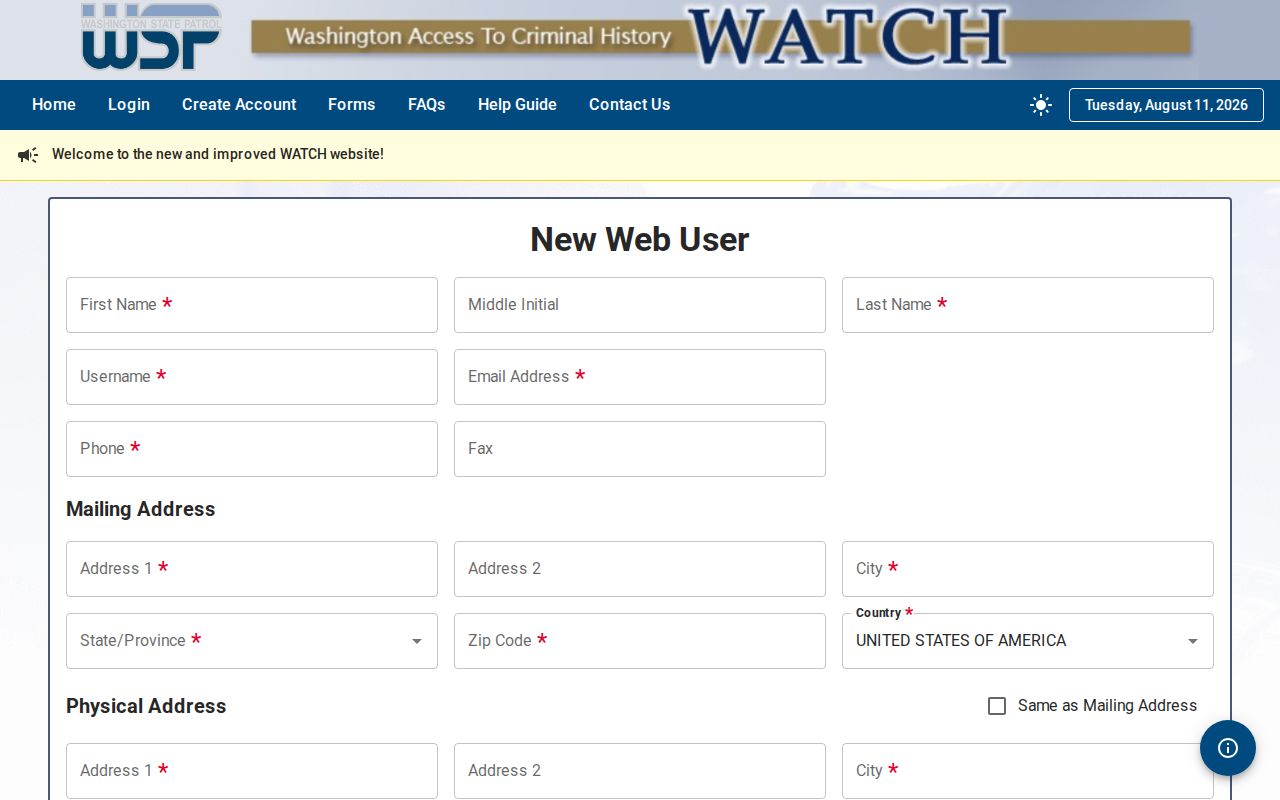
The acknowledgement makes clear that every search is charged and that a name match is not positive identification.
The WSP forms library provides public request and criminal justice forms.
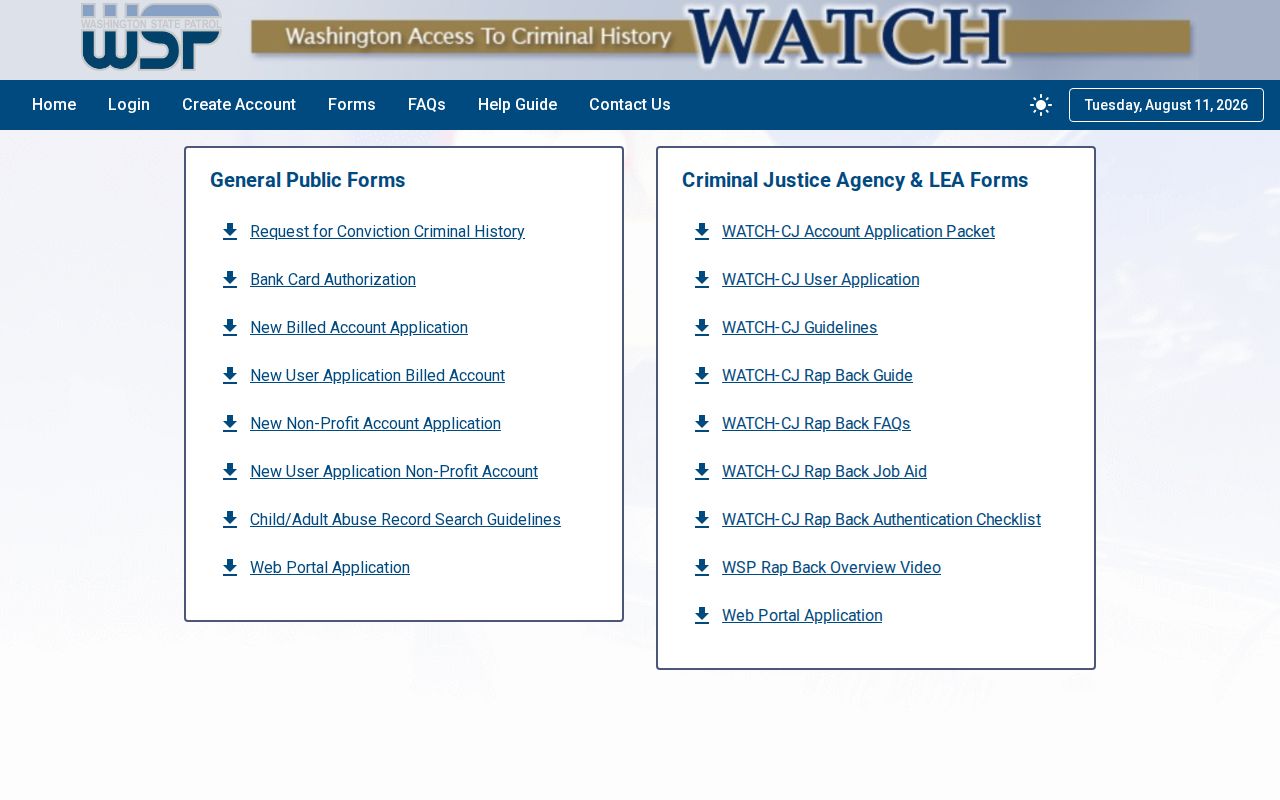
The form route is useful when a mailed name request, fingerprint request, or agency account is the right product.
Ordering a Check From WSP
Pick the Washington product by the question being asked. WATCH is best for the public statewide compilation. A mailed name request provides that public product through a form. A fingerprint-based request is the sound route for reviewing your own Washington record because fingerprints settle identity. If the goal is to inspect pleadings, orders, or the sentence in one case, use the court instead. WSP does not hold the complete docket.
- Choose WATCH, a mailed name and DOB request, or the fingerprint-based Washington check.
- Gather the required names, aliases, date of birth, requestor details, and a full fingerprint card when needed.
- Submit through WATCH or send the official WSP form by mail. A portal return requires an existing account.
- Pay the stated fee. Allow 24 to 48 hours for a pending WATCH review or seven to fourteen business days for mail.
- Read each entry, then obtain the county court file when a charge, outcome, or order needs source verification.
The official WSP criminal history request form shows the product, delivery, and identity fields.
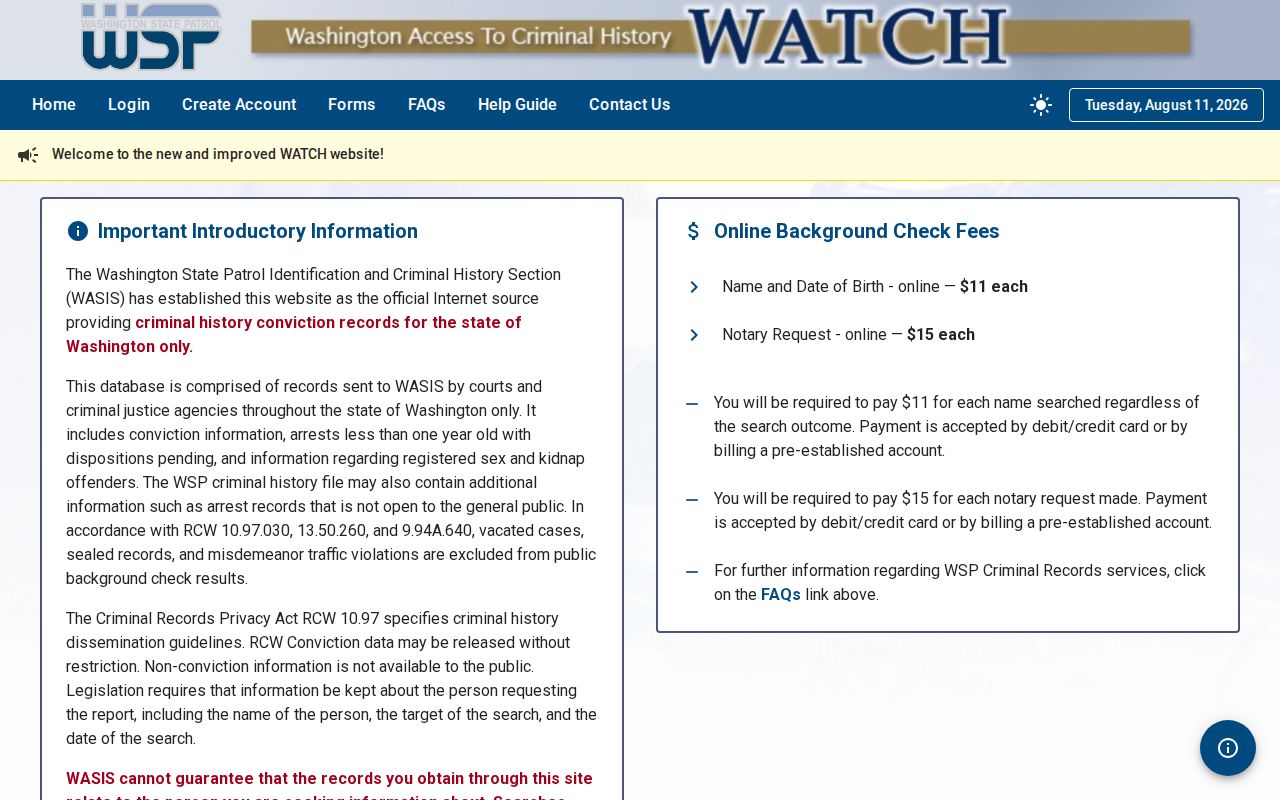
The current WATCH portal should be checked at submission time because its notary fee can supersede an older PDF amount.
Why WSP Fingerprints Resolve Identity
A name and date of birth narrow a search, but they do not prove identity. People can share names and birth dates. Spelling, former surnames, aliases, and data-entry differences can produce a no match or a candidate match. WATCH labels include no exact match, duplicate match, exact match available, and pending. Even an exact match remains a name-based result.
A full fingerprint card lets WSP compare biometrics against ABIS. That makes the fingerprint route the better choice for checking your own Washington criminal history and preparing a challenge. WSP charges $58 for the fingerprint-based record request. Its Olympia office lists a separate $16 capture service. Local police and sheriff agencies may provide cards by appointment with their own fees and ID rules. Washington has no single verified public commercial enrollment vendor for this personal WSP request.
The national layer is separate. A person can request their own FBI Identity History Summary through the FBI electronic channel for $18 plus fingerprint capture or an approved channeler's fee. That national result does not replace a missing Washington county disposition or court order.
Note: Fingerprints confirm identity, but a certified county disposition may still be needed to prove the final case outcome.
County Records vs WSP Checks
WSP and county custodians answer different questions. A Washington State Patrol report compiles qualifying statewide criminal history into arrest and disposition lines. The county file shows the event in depth. It may contain the booking record, probable-cause statement, charging information, docket, orders, judgment, and sentence. Neither replaces the other. The compiled report can reveal that a case exists; the source file can prove what happened and whether the WSP line is current.
| Point | WSP Check | County Records |
|---|---|---|
| Coverage | Qualifying data reported from all 39 Washington counties | One local agency, jail, or court |
| Source | WASIS compilation linked to fingerprints and disposition reports | Original report, booking entry, docket, order, or judgment |
| Freshness | May lag while a result is sent and linked | Changes as the local case or custody record changes |
| Detail | Summary arrest cycles and public outcomes | Case events, documents, narratives, and local custody fields |
| Best use | Statewide compilation or fingerprint-based self-review | Verifying the source event and official outcome |
Washington Courts Search Case Records can help find the court and case number, but the index warns that it is not an official outcome and not a criminal history check. Obtain the source document from the court of record.
What WSP WATCH Excludes
The public WATCH return includes Washington conviction information, arrests less than one year old while a disposition is pending, and sex or kidnapping registration information. It excludes public access to older nonconviction information, sealed and vacated cases, and misdemeanor traffic violations. It is Washington-only. It does not provide a national FBI record, a complete local court docket, every police narrative, or every booking that never reached the repository.
Under chapter 10.97 RCW, conviction data may be disseminated without restriction, while public nonconviction criminal history is limited. A vacation changes ordinary repository dissemination but does not automatically seal the court docket. A separate court rule and process govern sealing. That is why a WSP report can stop displaying an item while a public court entry remains, or a county docket can be corrected before the repository catches up.
The official WATCH pamphlet describes coverage and name-match limits.
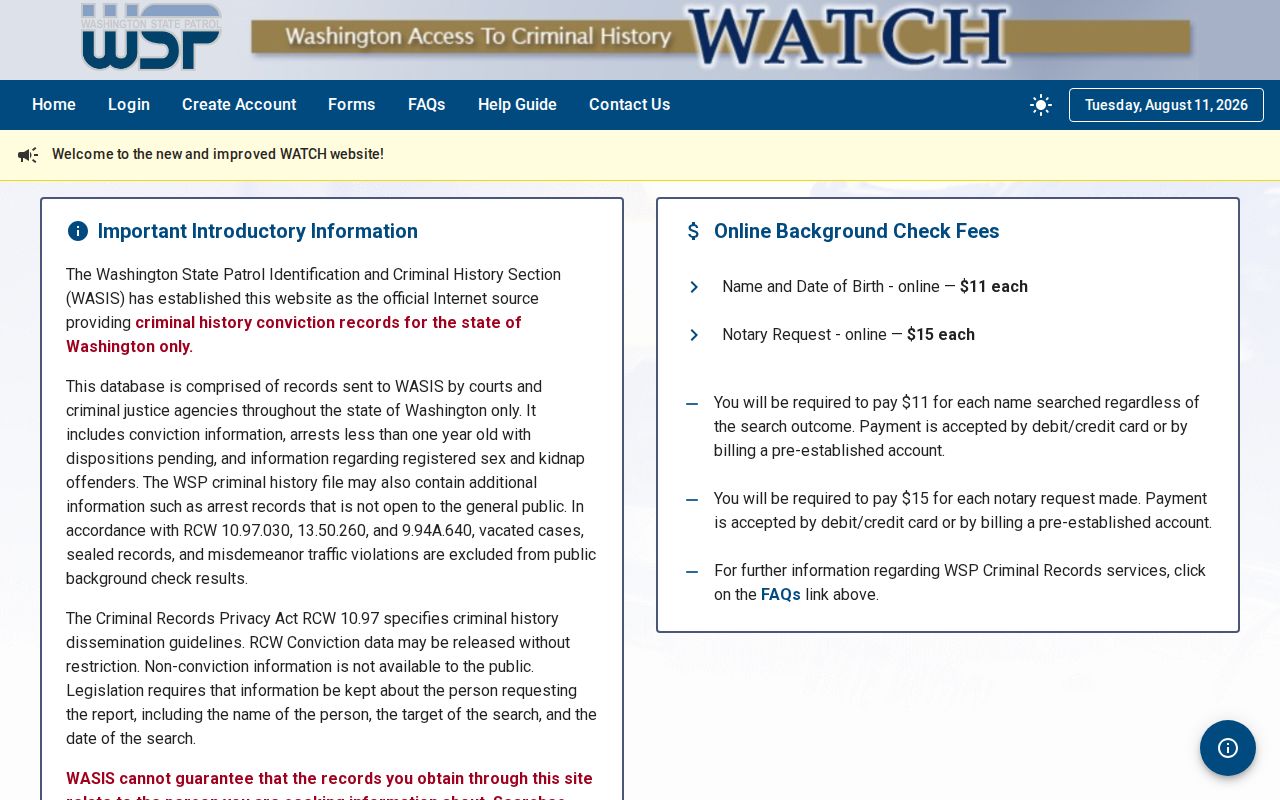
Its completeness warning is a practical reason to confirm a disputed entry with the originating agency and court.
Fixing Errors in a WSP Record
Begin with a fingerprint-based copy of your own Washington record. That avoids challenging a similarly named person's result. Mark the exact arrest cycle, charge, disposition, identifier, or demographic field that appears wrong. Then identify the source. A court controls its docket and disposition. The arresting agency or jail controls its arrest and booking fields. WSP cannot rewrite a source order merely because the WATCH output is questioned.
- Order your own fingerprint-based Washington record and identify the exact disputed line.
- Get the final order, dismissal, judgment, or booking correction from the county source that created it.
- Correct the source court or agency first, then send WSP identifying fingerprints and certified supporting proof.
- After processing, obtain a fresh report and confirm both WASIS and the county source now agree.
Use crimhis@wsp.wa.gov or 360-534-2000 option 5 for record questions. If the source is correct but WATCH remains wrong, provide the certified source result to WSP. If WSP is correct while the court portal remains wrong, return to that court. RCW 10.97.060 also provides a separate request route for deletion of qualifying nonconviction agency data, subject to time rules and statutory exceptions.
Note: A WSP correction changes the state compilation; it does not by itself amend, vacate, or seal the county court file.
WSP Versus FBI Record Checks
A fingerprint-based WSP check searches the Washington repository. An FBI Identity History Summary searches the national file maintained by the FBI and is available to the subject of the record. The FBI route uses fingerprints and costs $18 before capture or approved channeler fees. It can expose a multistate or federal item that a Washington-only report cannot show. WSP, however, remains the agency that can research and correct a WASIS compilation error.
Neither report substitutes for the local case file. The court can supply a certified disposition that is missing from a state or national summary. That source document may then support a challenge. Use WSP for Washington record review, the FBI channel for your own national identity history, and the county court for the original case outcome. This three-part approach keeps system scope clear and avoids treating a portal result as proof beyond what it actually holds.