
Running a Sex Offender Check in Washington
The Washington Sex Offender Public Registry, commonly called WASOR, is the main public search for the state. It draws on registration data gathered by county sheriffs and held in the central registry maintained by the Washington State Patrol. The Washington Association of Sheriffs and Police Chiefs supports the OffenderWatch public interface. The portal is meant for personal, family, and community safety. It is not a complete criminal history search, and it is not a list of all people with a sex offense.
Start with the question you need to answer. A name search can help confirm whether a known person has a published Washington registry profile. An address, city, ZIP, or county search can show published registrants around a place. The National Sex Offender Public Website adds participating jurisdictions outside Washington. When the issue concerns a registration date, risk classification, or local notice, use the Washington county directory. The sheriff is the local source.
The WASPC registry guidance shows how Washington risk levels and public access fit together.
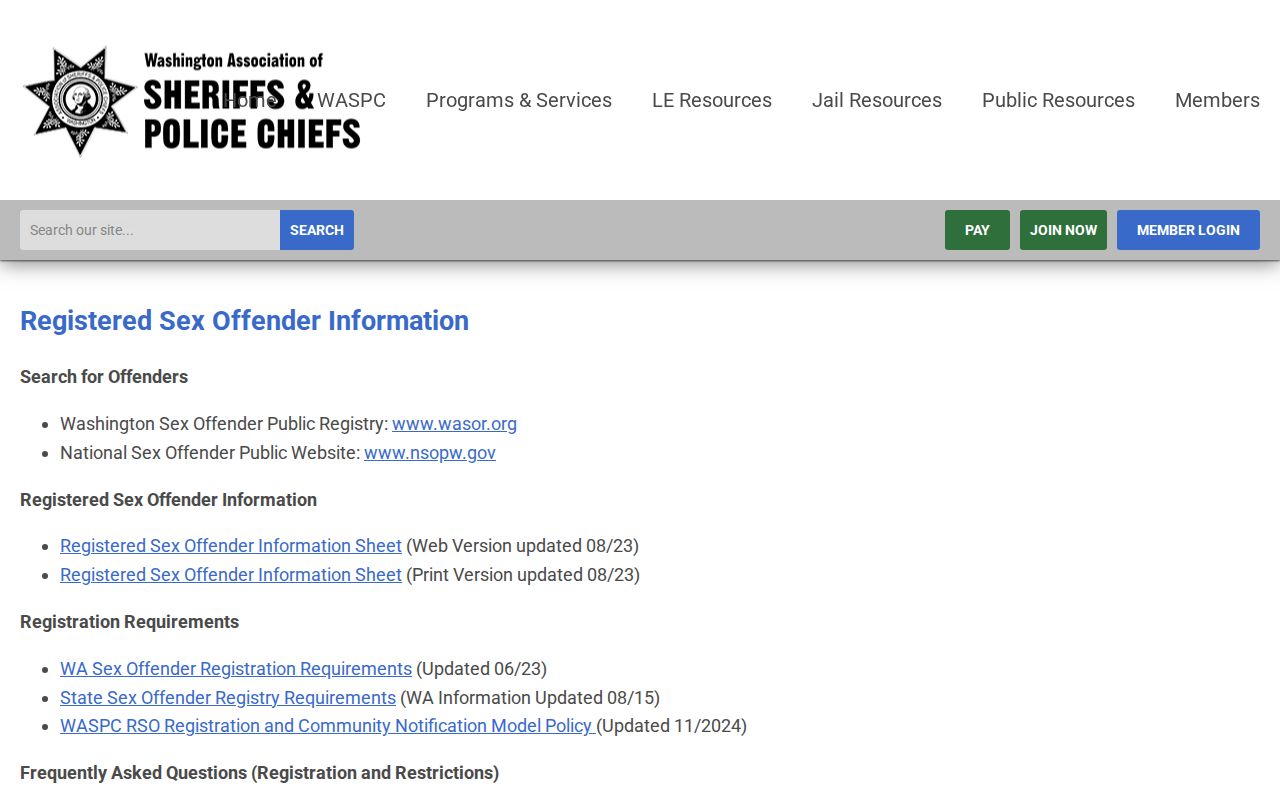
That guidance is vital because a missing public profile does not prove that no duty to register exists.
Why Washington Level I Listings Differ
Washington uses risk-based public disclosure. Level II and Level III registrants appear on the public registry. A Level I registrant usually does not appear when compliant and living at a fixed address. Public access expands when a Level I registrant is noncompliant or lacks a fixed residence. Registered kidnapping offenders may also appear as law permits. This means a no-result response has a narrow meaning. It says the public WASOR search did not return a published profile for the terms entered.
A specific inquiry about a compliant Level I registrant goes to the relevant county sheriff. That is a lawful access route set out in Washington's disclosure system. It is not a reason to assume the statewide portal is broken. Name spelling, aliases, partial matches, geocoding limits, and the selected geography can also change results. Confirm a possible match with the profile photo, aliases, physical description, and conviction fields before drawing a conclusion.
Note: Washington risk levels control public notice, while offense class and history control how long registration lasts.
How to Search the Washington Sex Offender Public Registry
WASOR supports both person and place searches. The statewide gateway first routes a visitor to a county or participating tribal registry. A proximity search uses a street address, city, state, and ZIP. A person search can use a full or partial first and last name, and aliases are included in matching. Search broadly, then narrow the result. The map can miss an address that cannot be electronically geocoded, and a city or ZIP boundary can leave out a nearby address just across that line.
- Open WASOR and select the county or participating tribal registry that covers the place being checked.
- Search by name, or enter an address, city, and ZIP for a proximity search.
- Open a result and compare its photo, aliases, physical description, address type, and conviction information.
- Use the alert link to save a physical address and email for notices about published registrants within one mile.
| Field Label | Type | Required | Notes |
|---|---|---|---|
| County | Map or list | At gateway | Routes to county sheriff and participating tribal instances. |
| Last and First Name | Text | No | Allows partial matching and searches aliases. |
| Address, City, State, ZIP | Text and dropdown | For proximity | Street, city, Washington, and five-digit ZIP drive the location search. |
| County or ZIP | Alternate geography | No | Offers broader geographic search choices. |
| Map and View Details | Result controls | No | Shows a mapped public location and opens the full profile. |
| Email Alerts | Signup | No | Saves an address for one-mile alerts about published registrants. |
Note: Search results can omit an address that the mapping system cannot geocode, even when the underlying registration is current.
Washington Registry Risk and Duration
A common mistake is to read Level I, II, or III as a sentence length. In Washington, a level describes assessed risk and the scope of community notification. It does not set the registration term. Duration instead depends on factors such as the offense class, prior qualifying history, whether the conviction came from Washington or another jurisdiction, and whether the case is adult or juvenile. A Level III person can have a fixed term in one case, while a Level I person may have an indefinite duty in another.
Under RCW 9A.44.140, an adult Washington Class B registration commonly runs for 15 community years when the statutory conditions are met. A qualifying Class C or comparable duty may run for 10 community years. Class A, prior qualifying convictions, sexually violent predator status, and many federal, tribal, or out-of-state convictions can carry indefinite registration. Current juvenile duties can be two or three years. Relief rules can change an individual result, so the portal level alone is never enough.
Inside a Registry Profile
A public Washington registry profile combines identity, location, risk, compliance, and offense fields. Read those fields as a current public safety record, not as a full court file. A legal name may be paired with aliases. A photo and physical description help separate people with similar names. The location can be a residence, a transient status, or another published location type. The offense section identifies the relevant conviction and jurisdiction, while the level reports local community-notification risk.
| Name & Aliases | Legal name plus aliases entered in the registry. |
|---|---|
| Photograph & Description | Photo, sex, race, height, weight, hair, eyes, and listed marks when published. |
| Registered Location | Public address, city, ZIP, address type, transient status, and hundred-block map where allowed. |
| Offense Details | Relevant conviction, date, jurisdiction, and statute or offense detail when supplied. |
| Risk Level | Washington Level I, II, or III community-notification classification. |
| Compliance Status | Shows whether the published record reports compliance, noncompliance, or transient status. |
Social Security numbers and fingerprints are collected for the central registry but are not public profile fields. Victim identity is not part of a lawful public profile.
Note: A registry profile is a public safety record, not the full judgment, sentence, or supervision file.
Washington Registry Email Alerts
OffenderWatch lets a user register an email address and physical address for alerts. The system sends notice when a published registrant is entered within one mile of that saved point. It is useful for ongoing neighborhood awareness because it does not require a fresh manual search each week. The service still follows the public-visibility rules. Most compliant Level I registrants remain outside the public portal, so they also remain outside this published-record alert.
The national registry search can supplement WASOR when a question crosses state lines.
NSOPW searches participating jurisdictions, but each source state controls which records it makes public.
Washington's FY 2023-24 program report recorded 3,713 new alert registrations and 274,870 email notices. Those are service events, not a count of newly registered people. Notification also occurs through local methods such as websites, mailed notices, hand-delivered flyers, or community meetings. The method and audience depend on risk level and local circumstances.
Washington Registration Requirements and Levels
Registration is completed in person with the sheriff. RCW 9A.44.130 requires identity, address or planned locations, birth information, conviction details, photograph, and fingerprints. A person released into the community generally registers with the residence sheriff within three business days. The same period applies after sentencing without confinement, establishing residence, or moving to a new county. A registrant without a fixed residence reports weekly in person.
| Level or Category | Public Meaning or Duration | Address Check |
|---|---|---|
| Level I | Low assessed risk; usually not public when compliant. Duration is separate. | Agency verification every 12 months |
| Level II | Moderate assessed risk; public. Duration is separate. | Agency verification every six months |
| Level III | High assessed risk; public with broad notice. Duration is separate. | Agency verification every three months |
| Adult Class B, no prior | 15 community years if statutory conditions remain met. | Based on separately assigned level |
| Adult Class C, no prior | 10 community years if statutory conditions remain met. | Based on separately assigned level |
| Indefinite categories | Class A, prior qualifying history, specified outside convictions, or sexually violent predator status. | Based on separately assigned level |
The published verification cycles are funded agency address checks. They are not a claim that each registrant personally reports on that schedule. Separate duties still apply after moves, travel, and other changes.
The Legislature's Washington registration duties text displays the detailed statutory rules.
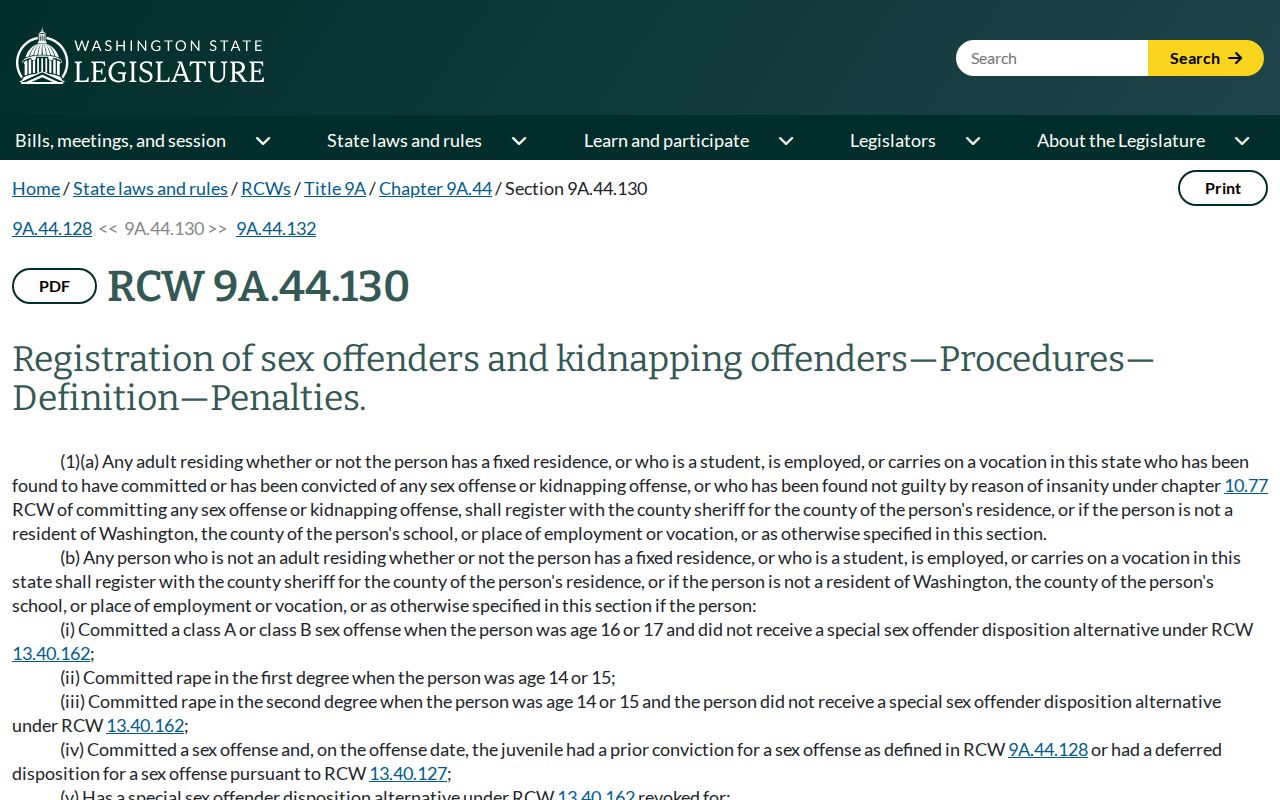
The statute is the right place to verify a deadline that may depend on residence, custody, travel, school, work, or name changes.
Correcting a Washington Registry Listing
Use the profile's tip or correction control when a public listing appears wrong. State which field is in question and provide the source information that supports the concern. For address, compliance, or local classification issues, contact the sheriff that holds the registration. A sheriff can investigate whether a duty ended by operation of law under RCW 9A.44.141 and ask the Washington State Patrol to remove the central record when verified.
Do not confront the listed person. A registry correction is an official records task. The sheriff and state repository must compare the report with the source registration, conviction, court order, and statutory duty. If the issue is the conviction itself, the court of record is the source. If the profile is correct but the map pin is not, geocoding can be the cause. Report the mapping issue through the profile control and explain the address discrepancy.
Note: A changed risk level, corrected address, and ended registration duty are distinct updates that may require different proof.
Washington Registry Residency Rules
Washington does not impose one universal lifetime distance ban on every registrant. Restrictions can arise from a sentencing order, county probation, Juvenile Rehabilitation, or Washington DOC community custody. A statutory community protection zone can mean an area within 880 feet of a school for specified supervision rules. That limited definition should not be turned into a statewide claim about every listed person.
Someone who has completed supervision generally may live where they choose unless another law or order applies. The profile alone does not display every condition of supervision. Check the sentencing court or supervising authority for the actual restriction. Local questions belong with the sheriff or court, reached through the county directory. This distinction matters when a map shows a home near a school, park, library, or child care site. Proximity by itself does not prove a violation.
Note: A map distance does not establish a violation without the specific Washington law, sentence, or supervision condition that applies.
Lawful Use of Registry Data
Washington publishes registry information for safety and community awareness. RCW 4.24.550 defines risk-based public disclosure and community notification. Level I disclosure is narrow. Level II notice can extend to nearby neighbors and organizations that serve children or vulnerable people. Level III information can be released to the public at large. Local law enforcement may use mail, websites, flyers, direct delivery, or meetings when a person moves into an area.
The statute and WASPC guidance prohibit using released information to threaten, intimidate, or harass. Washington research did not identify a special standalone offense called registry misuse, so the warning should not claim one. Threats, stalking, vandalism, assault, and harassment may be prosecuted under the ordinary laws that govern those acts. Report suspicious conduct to law enforcement. Do not attempt surveillance, contact, punishment, or retaliation.
The official Washington disclosure statute shows the lawful purpose and limits of public release.
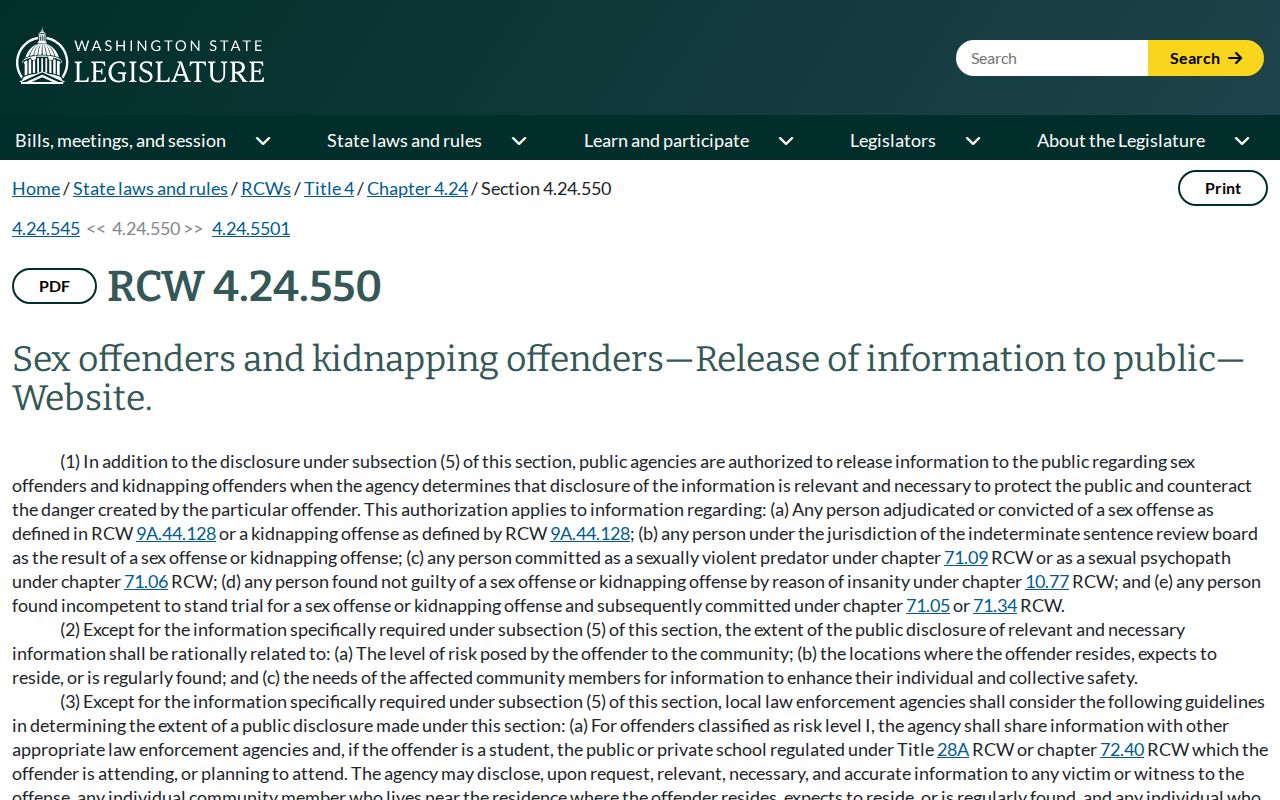
Its risk-based structure explains why public access varies by level, compliance, and local notice needs.
Use registry data lawfully. Washington registry information supports safety awareness. Never use it to threaten, intimidate, harass, vandalize property, stalk, assault, or confront a registrant.